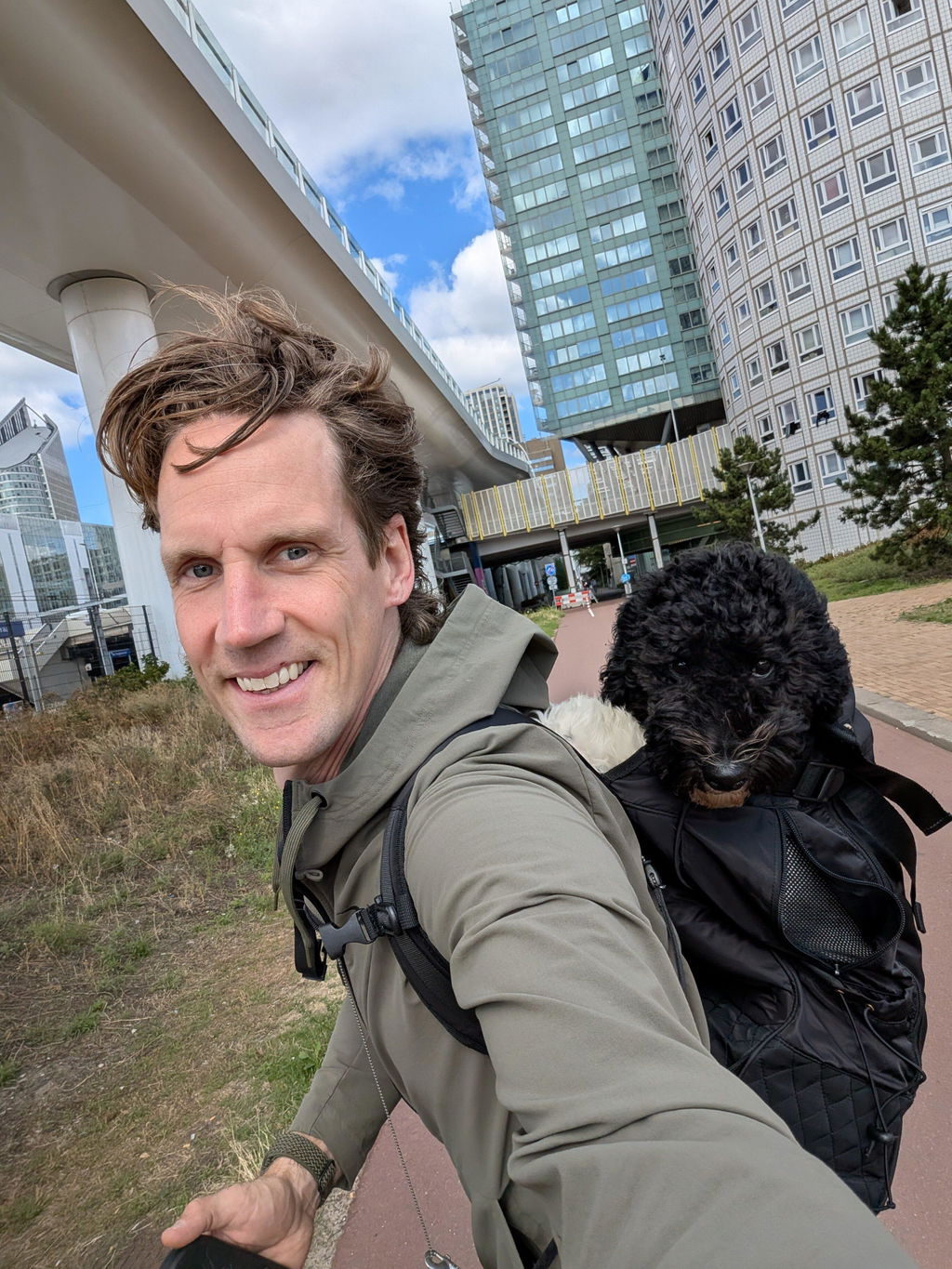

It's four in the afternoon, the car is still a long way off, and your small dog sits down in the middle of the pavement. Ears up, legs done, no plan to move.
That is the moment a dog backpack for long walks is made for. Let your dog walk for as long as it enjoys it, then carry it through the stretch it can't manage: small legs giving out, a hot pavement, a thick crowd, the train you still have to catch. Your dog still gets its walk, and you both get the whole day.
Our dog carrier backpack is built for days like that, with padded straps, breathable panels and an internal safety clip. Not sure which size? Measure your dog from the base of the neck to the base of the tail, tail excluded.
Which dogs need a lift on a long day
Small dogs
Chihuahuas, Yorkshire terriers, toy poodles, dachshunds and Jack Russells all have short legs, and short legs need more steps to cover the same ground. A small dog can set off at full speed and still run out of steps before you do.

So it walks the first part and rides the rest. Homies carriers are rated up to 20 kg and come in three sizes: XS for back lengths of 30 to 36 cm, S for 36 to 43 cm and M for 44 to 53 cm. Between two sizes, take the larger. You can see the full range in our dog carrier backpacks collection.
Very small dog? Read about a dog carrier for a dog up to 5 kg. Long back? The dog backpack for a dachshund guide covers what to check.
A backpack isn't the only format. If you're weighing it against a sling or a front carrier, this comparison of a backpack, sling or front carrier helps you choose.
Older dogs and dogs that tire sooner
Some dogs slow down with age, and a long day can ask more of them than a short one. A carrier lets them come along for the part they enjoy and rest for the rest. Let an older dog walk the easy part at its own pace, then lift it in for the stairs, the long queue or the last stretch home.
If your dog has joint or back problems, ask your vet first before using any carrier. And if your dog starts to limp, stop and see a vet.
Day trips in the city
A market on a Saturday, a museum garden, a ferry across the water, a café terrace with no shade. These are the days when a small dog walks happily for an hour and then wants to be anywhere else.
In a crowd, the bag keeps your dog off the floor and out of the way of feet and wheels. On a hot summer pavement, it keeps paws off the stone for the stretch between shade.
Marieke de Jong writes: “My mix breed doggie is super active but has joint issues, so when he gets tired, I pop him in the bag and we’re good to go.”
Your dog stays part of the day. It sits at your side on the ferry, looks around, and walks again when the pavement is kind.
The easiest rhythm is walk first, ride later. Your dog sniffs, stretches and does its business at its own speed, then rides through the crowd, the heat or the last stretch. Put it down again as soon as it perks up.
Try the bag on a short outing before the big day, so the first time in it isn't also the first time on a ferry.
Holidays with your dog
A holiday adds the awkward parts: a station platform with a suitcase, a queue for the ferry, a hotel lift, a new town with a lot of stairs. With your hands free, those get easier. Keep the carrier somewhere you can reach it, so you can lift your dog in the moment a platform fills up.

Pack the night before. This is the short list:
- Water and a travel bowl
- The carrier, already practised at home
- A harness that fits
- Treats for breaks and rewards
- Poo bags
Practise at home before you leave. Our guide to getting step by step into the backpack takes you through it.
Taking public transport? Check your operator before you book, because the rules for dogs differ from one operator to the next. Our guide to taking a dog on the train covers what to look at.
On the way: breaks, water and paws
A long day goes better with a rhythm. Stop when your dog needs a stop, and treat each one as a small reset for both of you.

- Take regular breaks so your dog can pee, drink and stretch.
- Carry water for both of you.
- Skip the hottest hours of the day in summer.
- Check paws and buckles at each stop.
Pavement, sand and cobblestones all feel different underfoot, so a quick look at the paws at each stop is worth the few seconds. Check the straps and the closure on the bag too, before you pick it up again.
If you're wondering about safety, read is a dog backpack dangerous? for how the bag is designed and when to use it.
Questions about long walks and holidays
How do I know when my dog wants to ride instead of walk?
Watch for a dog that sits down and won't move, lags behind you, or lies down in the shade. Those are signs it has had enough. Limping is different: stop and see a vet.
What should I pack for a day out with my dog in a backpack?
Water and a bowl, treats, poo bags and a harness that fits, plus the carrier. The packing list in the holidays section above has the full set.
Can an older dog still come on long walks with a carrier?
A carrier can cover the stretches an older dog can't walk. If your dog has joint or back problems, ask your vet first, and stop at the first sign of discomfort.
Can I take the dog carrier backpack on holiday by train?
Rules differ per operator, so check yours before you travel. Our train guide has what to look at, and we don't state a rule or a fee here.
Pick the colour for your next day out
The Homies dog carrier backpack comes in Olive Green and Black, in sizes XS, S and M. Each bag sold also donates a meal to a dog shelter.

Take a look at the whole range of dog carrier backpacks, and tag your dog along on the next long day.