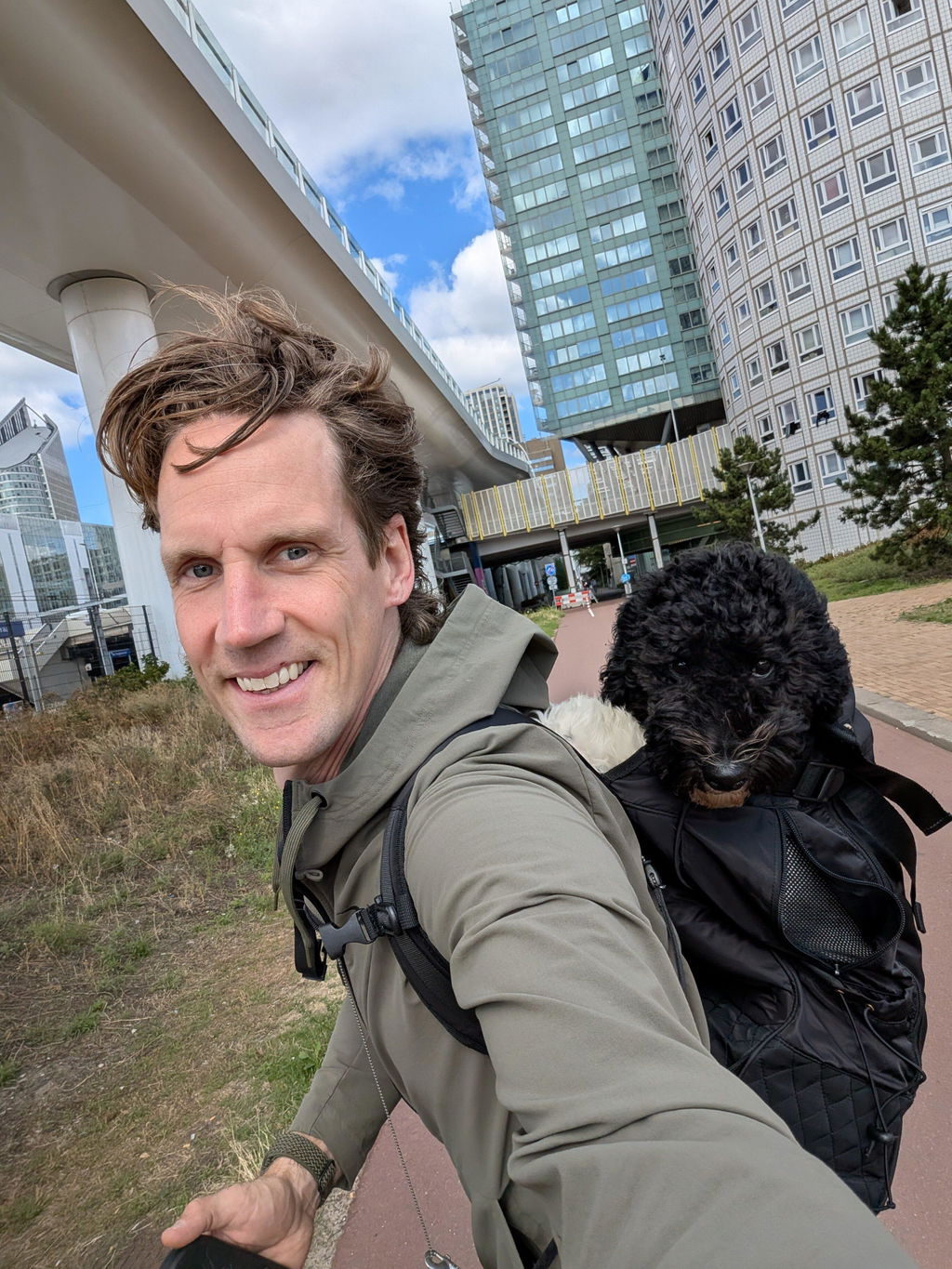

Small dog breeds fit a dog carrier backpack when the back length matches the size, and every Homies size is tested up to 20 kg. Our size guide names six breeds: chihuahuas, toy poodles and miniature dachshunds take XS, standard dachshunds and maltipoos take S, and small to medium labradoodles take M.
For every other breed, measure the back from the base of the neck to the base of the tail, tail excluded. Then read the chart: XS is 30 to 36 cm, S is 36 to 43 cm, M is 44 to 53 cm. Between two sizes, take the larger.
Below are 15 breeds for the Homies dog carrier backpack: the six on our sizing page and nine more worth a closer look. Breed is a starting point, and the tape has the final word.
Small dog breeds at a glance
The weights and heights come from breed standards. A standard describes the ideal dog, and the Royal Kennel Club says plainly that a dog might be larger or smaller than the figures in it.

| Breed | Figure from the breed standard | Size on our chart |
|---|---|---|
| Chihuahua | up to 2.7 kg | XS |
| Toy poodle | under 28 cm at the shoulder | XS |
| Miniature dachshund | ideal 4.5 kg, desired maximum 5 kg | XS |
| Standard dachshund | ideal 9 to 12 kg | S |
| Maltipoo | no breed standard | S |
| Small labradoodle | no breed standard | M |
| Yorkshire terrier | up to 3.2 kg | Measure first |
| Pomeranian | 1.8 to 2.5 kg | Measure first |
| Maltese | up to 25 cm at the shoulder | Measure first |
| Shih tzu | 4.5 to 8 kg | Measure first |
| Jack Russell terrier | 25 to 30 cm | Measure first |
| Cavalier King Charles spaniel | 5.4 to 8.2 kg | Measure first |
| Miniature schnauzer | ideal 33 to 36 cm | Measure first |
| Bichon frisé | ideal 23 to 28 cm | Measure first |
| French bulldog | ideal 11 to 12.5 kg | Measure first |
Not sure which row is your dog? Find your dog's size with the chart and the measuring note.
Six breeds our size chart names
Chihuahua
The Royal Kennel Club standard asks for a weight up to 2.7 kg, with 1.8 to 2.7 kg preferred. At that weight the scale settles little and the back decides, so keep the fur flat, run the tape along the spine and write the number down before you open the chart.
Usually: XS. Measure first.
Toy poodle
Josje Hermans writes: “sometimes it's too far and then the bag is really ideal (he's still young).” The Royal Kennel Club puts a toy poodle under 28 cm at the shoulder. Shoulder height says little about the back, so the tape still comes first.
Usually: XS. Measure first.
Miniature dachshund
Ideal weight for a miniature dachshund is 4.5 kg, with 5 kg the desired maximum, says the Royal Kennel Club for the smooth-haired variety. The body is long and the legs are short, which makes the back measurement the number that counts. Our dachshund in a backpack guide covers what to check with a long back.
Usually: XS. Measure first.
Standard dachshund
Same shape, more of it: the standard gives an ideal weight of 9 to 12 kg for the smooth-haired dachshund. Our sizing page places standard dachshunds that are not oversized in S. If the tape lands between S and M, take the larger size.
Usually: S. Measure first.
Maltipoo
We found no kennel-club standard for the cross, so there is no weight to quote. Both parent breeds are small. Their standards differ: the Royal Kennel Club has the toy poodle under 28 cm and the Maltese up to 25 cm at the shoulder. Picture two maltipoos from different litters at the same park, a size apart. That is why you measure.
Usually: S. Measure first.
Small labradoodle
Moos, The Netherlands, writes: “My little labradoodle fits perfectly and looks so adorable peeking out of the bag.” Our sizing page places small to medium labradoodles in M. There is no breed standard figure to cite for a cross, and "small to medium" covers a range. The tape decides.
Usually: M. Measure first.
Nine more small dog breeds: measure first
None of these nine is on our size chart's breed list, so we give the cited figure and leave the size to your tape. Measure the back, read the chart (XS 30 to 36 cm, S 36 to 43 cm, M 44 to 53 cm) and take the larger size when you land between two.

Yorkshire terrier
The standard says weight up to 3.2 kg. It describes hair on the body as moderately long, perfectly straight and glossy, with a fine, silky texture. Long, silky hair hides the neck, so part it at the base of the neck and again at the tail base before you measure.
Not on our chart's breed list. Measure first.
Pomeranian
Dogs weigh 1.8 to 2 kg and bitches 2 to 2.5 kg in the Royal Kennel Club standard's ideal. A Pomeranian has two coats, with a thick ruff around the neck, shoulders and chest. The ruff sits right where the neck measurement starts, so feel for the base of the neck under the fluff.
Not on our chart's breed list. Measure first.
Maltese
Picture a white Maltese at a tram stop, silky coat and all. The standard gives a height not exceeding 25 cm from ground to withers and no weight line. Press the silky coat flat for a clean reading from neck to tail base.
Not on our chart's breed list. Measure first.
Shih tzu
The Royal Kennel Club standard gives 4.5 to 8 kg, with an ideal of 4.5 to 7.5 kg, and a height at the withers of not more than 27 cm. That is a 3.5 kg spread inside one breed, so two shih tzus at opposite ends may not share a size. The outer coat is long and dense, so measure through it.
Not on our chart's breed list. Measure first.
Jack Russell terrier
The standard says 25 to 30 cm, and that substance and weight should be proportionate to height. It gives no weight number at all. The 20 kg rating on every Homies size is a ceiling you can check on a bathroom scale, while the back picks the size.
Not on our chart's breed list. Measure first.
Cavalier King Charles spaniel
The standard sets weight at 5.4 to 8.2 kg and prefers a small, well-balanced dog well within those weights. Check the weight against the 20 kg rating, then check the back against the chart.
Not on our chart's breed list. Measure first.
Miniature schnauzer
The standard gives ideal height only: 36 cm for dogs and 33 cm for bitches, and it calls too small, toyish dogs undesirable. At the shoulder that is taller than the Maltese, the bichon and the Jack Russell above. Height tells you little about back length, so measure the back anyway.
Not on our chart's breed list. Measure first.
Bichon frisé
Bichon fur is a good reason to measure twice. Press the coat flat, find the base of the neck and take the tape to the base of the tail. The standard gives an ideal height of 23 to 28 cm at the withers and no weight.
Not on our chart's breed list. Measure first.
French bulldog
The Royal Kennel Club standard gives an ideal weight of 12.5 kg for dogs and 11 kg for bitches, and it calls dogs showing respiratory distress or excessive respiratory noise unacceptable. The RSPCA says some flat-faced breeds cannot pant as effectively because of their shorter snouts, and that noisy or fast breathing is a sign of overheating. So a French bulldog is not a summer carrier dog: keep trips short, stay in shade, avoid the hot hours, and ask your vet first.
Not on our chart's breed list. Measure first.
Measure your dog's back in four steps
- Let your dog stand on a flat floor, relaxed.
- Find the base of the neck, where it meets the back.
- Run a soft tape along the spine to the base of the tail. Leave the tail out.
- Read the chart: XS 30 to 36 cm, S 36 to 43 cm, M 44 to 53 cm. Between two sizes, take the larger.
Measuring a puppy? The number will move, so read our puppy carrier guide first. The full chart sits on the size guide.

Questions about small dog breeds in a carrier
Which small dog breed is easiest to carry?
Among the breeds above, the lightest figures belong to the Pomeranian (1.8 to 2.5 kg), the chihuahua (up to 2.7 kg) and the Yorkshire terrier (up to 3.2 kg). Light helps your shoulders. The back still picks the size. For dogs in that weight class, see our guide to a dog up to 5 kg.
Can a French bulldog go in a backpack?
Only with care. The standard treats respiratory distress as a fault, and the RSPCA links flat faces to less effective panting. Short trips, shade, cool hours and a vet's say-so come first. Our article on whether a dog backpack is safe covers the wider safety question.
My dog is a mix. Which size?
Measure the back and read the chart. The maltipoo and the small labradoodle on our size guide are crosses too, and even there the tape settles it.
Up to what weight does a dog carrier backpack work?
Every Homies bag is tested up to 20 kg. Our guides to a dog up to 10 kg and a bigger dog up to 20 kg go deeper. Above 20 kg, this is not the bag.
Your dog, your number
You have the cited figures and the measuring steps. Take the tape, find the number and match it to the chart. See the Homies dog carrier backpack in XS, S and M, or browse all dog carrier backpacks.

Sources, checked 30 October 2026. Breed standards from the Royal Kennel Club (formerly The Kennel Club): Chihuahua, Toy poodle, Miniature dachshund, Standard dachshund, Maltese, Yorkshire terrier, Pomeranian, Shih tzu, Jack Russell terrier, Cavalier King Charles spaniel, Miniature schnauzer, Bichon frisé, French bulldog. Heat and breathing: RSPCA heatstroke advice. Maltipoo and labradoodle sizes: Homies size guide.