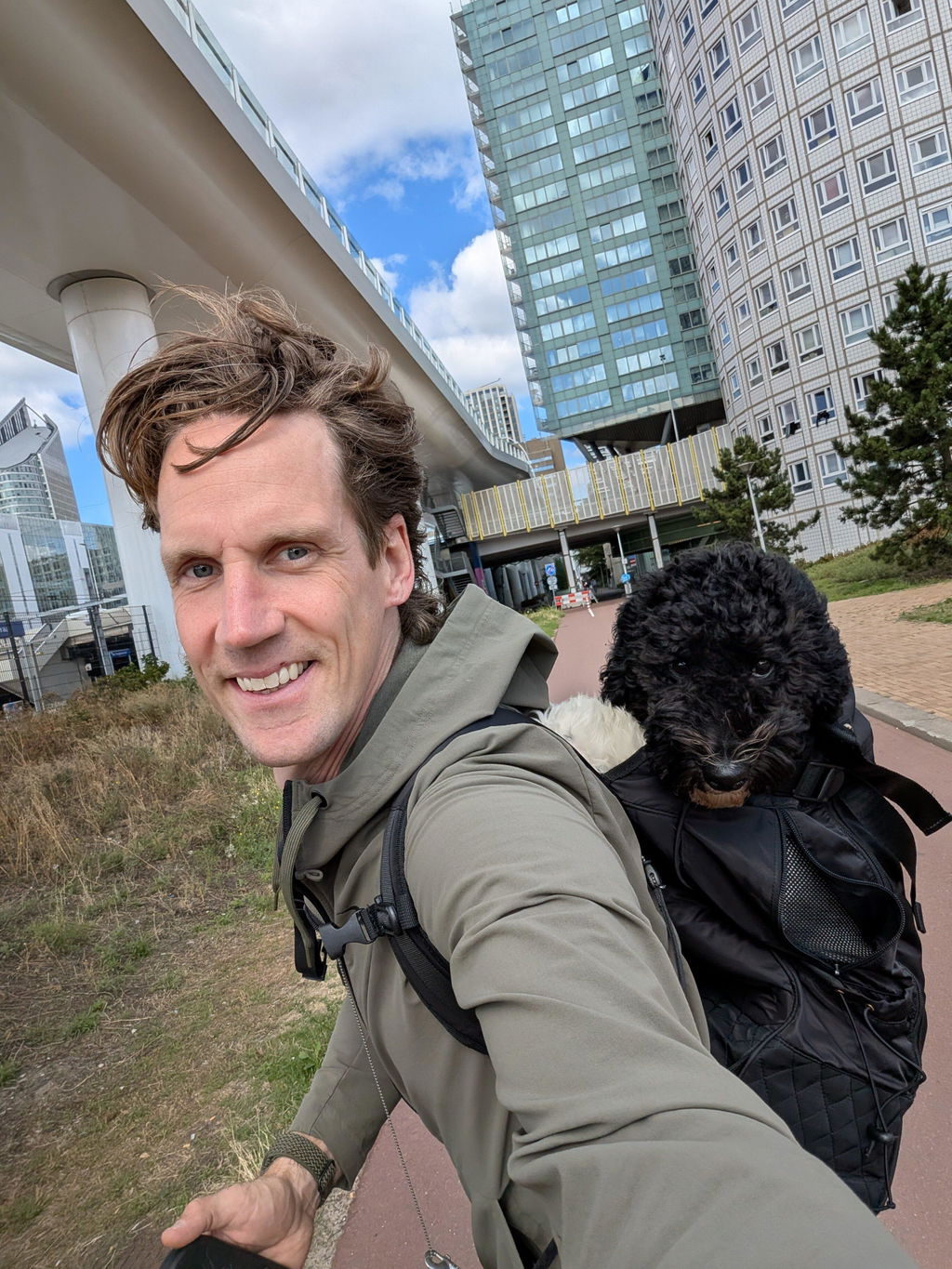

A dog backpack vs sling comparison has no single winner, because each carrier solves a different day. For a short errand with a very small dog, a sling or a shoulder bag is quick and light. For daily city life, cycling, public transport or a dog above our rule of thumb of 5 kg, a backpack carrier is the better pick: the weight sits on both shoulders, close to your back, and both hands stay free. Front carriers suit tiny dogs that want to see you, but they block your view of your feet.
That is the short version. If you want to see the format we make, have a look at our backpack carriers.
The 5 kg line is our editorial rule of thumb, not a fixed limit. Dogs sit differently, so the guide to a dog carrier for a dog up to 5 kg goes through the small end in detail.
The four dog carrier types in one table
| Carrier | Weight sits on | Hands free | On a bike | Wins at |
|---|---|---|---|---|
| Backpack carrier | Both shoulders, close to your back | Yes | Steadiest | City days, longer carries, bigger dogs |
| Sling (crossbody) | One shoulder, at your hip | One arm steadies it | Swings | Short trips, very small dogs |
| Front carrier | Your chest, held by shoulder straps | Yes | Tight to lean over | Tiny dogs that want company |
| Shoulder bag or tote | One shoulder | Partly | Awkward | Shops and short visits |
Read the table as a starting point. Three questions narrow it down fast: how long will you carry, do you need both hands, and what happens to the dog when the bag comes off? A short carry with free hands points to a sling or tote. A long carry or a busy commute points to the backpack.
Want a closer look at the backpack format? Meet the Homies dog carrier backpack.
Backpack carrier: the one for daily carrying
Two straps share the load across both shoulders, and the dog sits close to your spine, so nothing pulls to one side. That is why a backpack carrier wins on long carries and on a bike: the bag moves with you.

Ours has padded straps, breathable panels, an internal safety clip and holders for a water bottle and a leash. It was developed with veterinary professionals, and it is rated up to 20 kg. The M size even fits a laptop, which helps on a day that starts at the office and ends at the park. For the full checklist, read what makes a good dog backpack.
The downsides: the dog sits behind you, so you can't see its face and you check by feel. And taking the bag off in a tight cafe takes some choreography. For a two-minute errand, a tote is faster.
Sling (crossbody): quick and light
A sling goes on in seconds and rests at your hip, where you can see the dog and rest a hand on it. For a very small dog and a short trip, it is hard to beat.
The cost is the strap. The whole weight hangs from one shoulder, so you hitch it up, lean to the other side or switch shoulders. On a longer walk the strap digs in, and when you walk fast or pedal, the bag swings.
Front carrier: for tiny dogs who want company
A front carrier keeps the dog against your chest, facing you or tucked in. You see each other all the time, which a nervous small dog may like, and it is the easiest format for talking to your dog.

The trade-offs are practical. The bag blocks your view of your feet, which matters on kerbs and stairs. On a warm day you and the dog heat each other, and bending forward squeezes the space the dog sits in.
Shoulder bag or tote: shops and short visits
A tote looks like a normal bag, so it slips into a shop or a quick visit without fuss. There are no straps to adjust and nothing to put on.
It also takes one shoulder and keeps one arm busy steadying it. Some openings give the dog little to look out of, and the weight hangs to one side.
Not to be confused with: backpacks a dog wears
Saddlebag packs strap onto the dog's own back so the dog carries gear. They are a different product from a carrier, which carries the dog.
Which one for you? Five quick scenarios
Here is how those answers play out on five ordinary days. Your own dog and route will shift the answer, so treat these as a map.

- The bike commuter. Both hands on the handlebars, a dog on your back, a bag that doesn't swing. Backpack. Our guide to cycling with your dog covers the rest.
- A 3 kg chihuahua and an oat flat white. Ten minutes, one cafe, one very small dog. A sling or a tote wins here, and we're happy to say so. If your dog is in this weight range, read about a dog carrier up to 5 kg.
- A 12 kg dog with tired legs. The walk out is fine, the walk home is slow. Backpack. Measure from the base of the neck to the base of the tail, take the larger size if you land between two, and check the size guide.
- The train to Paris. You need hands for tickets, a suitcase and stairs, so a backpack makes the day easier. Rules for bags differ per operator, so check your operator first. The dog on the train guide has the details.
- The puppy that is meeting the street. Short walks, then a lift when the legs are done. A sling or a backpack both work, depending on how long you carry. More in our puppy carrier guide.
FAQ
Is a sling or a backpack better for a dog's back?
We can't answer that as vets, so here is what we can say from how the formats work. Look for a flat base under the dog's body and a seat where the dog sits comfortably. A backpack holds the dog against your back, a sling cradles it at your hip. For advice on your own dog, ask your vet.
What is the difference between a sling and a carrier backpack?
A sling is a single-strap bag worn crossbody, with the dog at your hip. A carrier backpack has two straps and sits on your back. A front carrier hangs on your chest, and a tote is a bag you carry on one shoulder or in your hand.
Which carrier is best for cycling?
A backpack carrier, because it sits close to your back and doesn't swing the way a sling does. Our dog backpack for cycling guide goes through the ride in detail.
Can I take my dog on the train in a sling?
It depends on your operator. Rules about the bag differ, and some operators specify what counts as a suitable one. Check your operator before you travel, and read our dog on the train guide for the sourced rules.
If your days are city days, with a bike, a tram or a dog whose legs give up before the walk does, try the Homies carrier in olive or black. Not sure about size? Start with the size guide.